www.JohnCunyus.com
Translator, Publisher, Web Designer
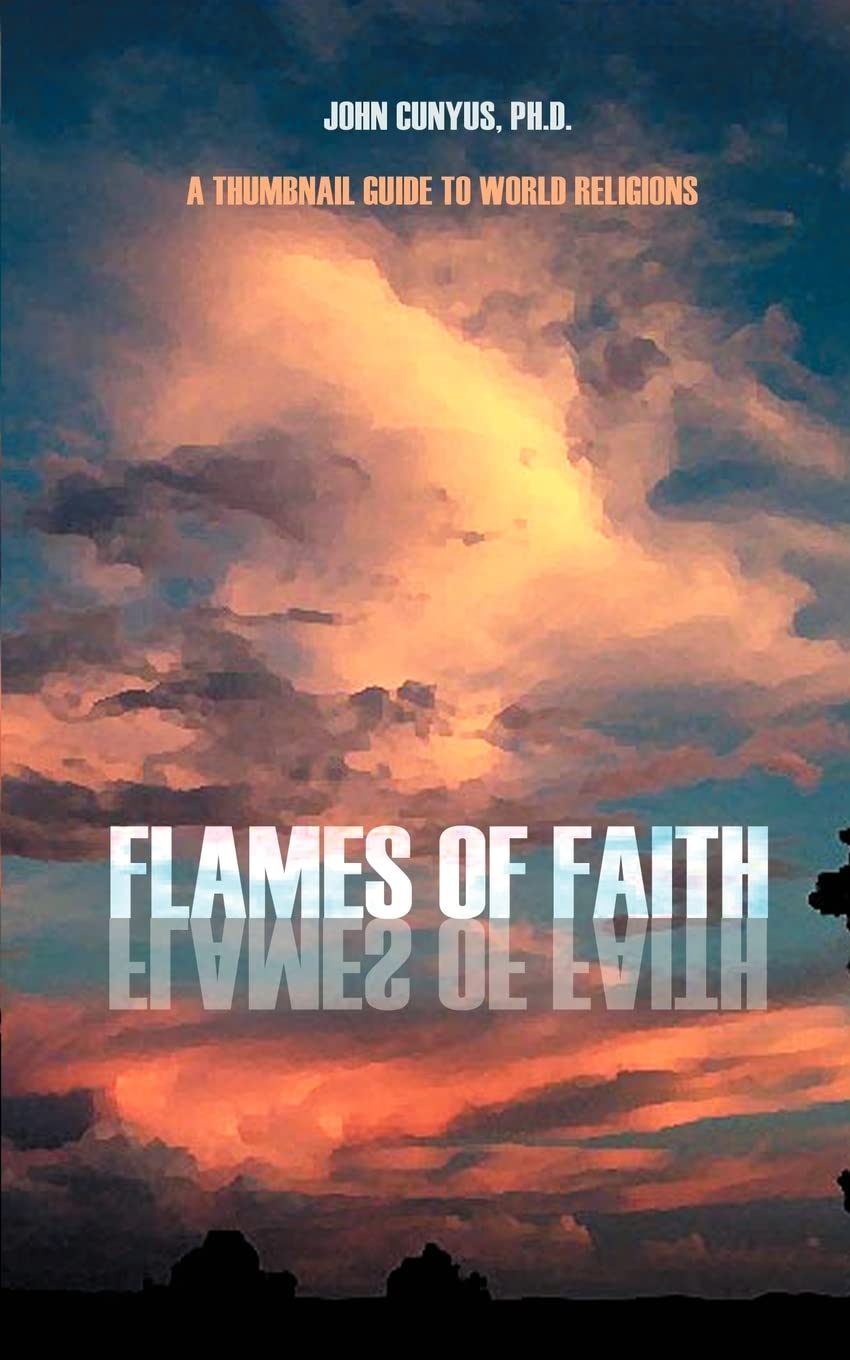
Flames of Faith
A Thumbnail Guide
to World Religions
John Cunyus
©2006, All Rights Reserved
www.johncunyus.com
To the One whose kingdom has no end.
TABLE OF CONTENTS
Consumerism
Introduction The horrific events of September 11, 2001 forever
shattered our illusion that the only religion which
matters is our own. When the hijacked airliners flew
into the World Trade Center, the Pentagon, and a
lonely Pennsylvania hillside that morning, the world
realized with chilling clarity that the religious
imaginations of people in far away lands now
mattered to all. Some sort of understanding of the world’s great
religious traditions is now essential to our political
security, perhaps even to our own survival. We need
to understand, roughly at least, what other people
believe and why they act the way they do, if nothing
else to defend ourselves from future attacks.
Comparative religions is no longer an academic
endeavor. In our world today, we watch the spectacle of nuclear-armed India and Pakistan, divided fiercely by religion
as well as other issues, facing off over the “line of
control” in Kashmir. We see the continuation of the
centuries-old conflict between Protestants and Roman
Catholics in Ireland. We see a religious element in
the standoff between Israelis and Arabs in the Middle
East. And around the periphery of the world,
countless fires are fueled at least in part by religious
extremism. Understanding what’s going on may hold
one very important key to the future. We see all too
plainly the results of failing to understand. Defining Religion To begin with, we need to define the word “religion.”
One dictionary definition is: Belief in a superhuman being or beings, esp.
a personal God, controlling the universe and
entitled to worship; the feelings, effects on
conduct, and the practices resulting from such
a belief; a system of faith, doctrine, and
worship.
While that definition seems well and good, it does
convey a Western, theistic bias. Religion, as
practiced among human beings today, does not
necessarily imply belief in God or gods. Theravada
Buddhism, practiced in Sri Lanka, Burma, and
Thailand, does quite well without a god, for instance.
We need to broaden the definition to understand it
better. The word “religion” itself derives in part from a Latin
word, religare, meaning “to bind.” Perhaps we
should move back in the direction of the Latin
definition. Religion is something that binds us – to
ourselves, our family, our social group, our world, our
universe. It binds the way we behave, the way we
worship, the way we understand. Using a simpler,
non-theistic definition, we see that all human beings
are religious, in a sense. All human beings are bound
to others. All human beings are bound to particular
ways of seeing themselves and the universe they
inhabit. All human beings are bound by certain
ethical standards, however unethical they may seem
to others. Religion is our most basic orientation in life. We
have a basic orientation, a basic way of seeing,
feeling, acting, and understanding, whether we are
aware of it or not. To be human is to be religious.
Admittedly, this complicates our understanding at
first. Some people pride themselves on being
members of one particular religion. Yet the practical,
binding religion they practice may bear only a slight
resemblance to the formal religion they claim. Others
may be equally proudly non-religious. Yet that
defiant non-religion or irreligion easily falls within
our definition of religion as well. Seeing religion as a human being’s basic orientation
to life both complicates and simplifies. It
complicates to the extent that it blurs the lines
between religions, as outlined above. It simplifies in
that it focuses on what humans truly believe and
practice, not merely on what they say they believe and
practice. How to Understand Studying “other” religions raises inherent questions.
Many of us come to such a study with very strong
religious convictions of our own. Those convictions
may cause us from the start to see the other traditions
as totally alien, as demonic, as the enemy. We may
study simply in order to find weaknesses in the
enemy’s armor, the better to defeat him in the future.
While such approaches are probably inevitable, they
probably will not lead us to a better understanding. In
our religious universe, there may well be only one
Master. Yet in the flesh and blood world around us,
there are many masters, many ways, all of which have
some sincere adherents. Some of those may have
important lessons to teach us, even as we may have
lessons to teach them. I prefer an approach that will acknowledge our own
religious convictions, not abandon who and what we
are, yet will still keep an open mind toward the
beliefs and practices of others. As we study the
world’s religions, we will find much that fascinates
us. We will also probably find much that repels us.
If we’re honest, though, we have to admit the same
thing about our own religion as well. It’s impossible, of course, to fully explain great
religious traditions in the limited space we have here.
What I hope to accomplish is provide a thumbnail
description of each. Such descriptions leave an
incredible amount of information out. Hopefully,
they offer enough information to form a springboard
to a rough understanding. If they awaken an interest
in a fascinating topic and inspire further study, so
much the better. I describe in this work Hinduism, Buddhism, Chinese
Religions, Judaism, Christianity, and Islam.
Certainly, that list is not exhaustive. I have left many
out. Yet these religious traditions, in my opinion,
exert the greatest influence in our world today. I also include a brief study of a religious perspective
I call Consumerism – the predominant social pattern
of the contemporary West. Some would not consider
this a religion at all. After all, it has no gods ...or
perhaps too many gods to name. But this lifestyle
does bind its adherents along the lines of the ancient
Latin definition of religion. It exerts an enormous
influence on the world. It is syncretic, in that it
absorbs elements of many other religious
perspectives. In many places, this consumerist
Western religion triggers the conflicts raging between
the other traditions in the world today. Hinduism A Key Text: There was not then what is or what is not. There was
no sky, and no heaven beyond the sky. What power
was there? Where? Who was that power? Was there
an abyss of fathomless waters?

Only that god who sees in highest heaven: he only
knows whence comes this universe, and whether it
was made or uncreated. He only knows, or perhaps
he knows not.
– from The Rig Veda, x, 129
Overview:
Hinduism, the predominant religion of India, is not simply one religion. It is an umbrella under which are found many different gods, rites, and devotions. The word Hindu comes from the name of the Indus River in present-day Pakistan, which flows through the home of the most ancient strands of South Asian culture.
The principle Hindu gods are Vishnu, the sustainer of the universe, and Shiva, seen as not only the creator of all things but as the destroyer as well. Alongside Vishnu and Shiva are a bewildering variety of other gods and goddesses. Allegiance to one absolutely does not preclude worship of another.
Hinduism is syncretic, meaning it consistently adapts itself through the centuries by adding new understandings, new gods, and new practices to its preexisting ones. Hinduism has no church and no formal creed, as such.
Beliefs:
The Vedas: Though the outward forms of Hinduism are bewilderingly varied, there is an inner core of belief that unites Hindus into one religious perspective. Formally, all orthodox Hindus accept the authority of the Vedas, a collection of ancient sacrificial law, poetry, and speculation associated with the Aryan conquerors who overran India some three thousand years ago.
Much of the sacrificial system embodied in the Vedic literature has long since ceased to be actively practiced. Still, Hindus accept the ancient Vedic texts as scripture. In contrast, Buddhism and Jainism, both religions that were also born in India, do not accept Vedic authority.
The Absolute: Most Hindus believe in an impersonal absolute, Brahman, which underlies all things. The gods, humanity, indeed all that is, are manifestations of this ultimately unknowable, indestructible Brahman.
The deepest reality of any individual, the Atman, corresponds with the ultimate principle of Brahman. Thus, the Self of the individual and the Self of the universe are one and the same. It is important to note that our individual personalities are not the same thing as the Atman. Atman makes possible our individual personalities. It does not, however, suffer through the changes and heartaches of life with the individual personality.
Karma and Reincarnation: Atman is an inner reality and our senses are made to look outward. For this reason, living beings tend to identify themselves with the outer world and live in ignorance of their genuine identity with Atman. We live by the Atman, in ignorance of the Atman.
Our actions in the world bind us all the more strongly to the world. These actions, known as karma, have inevitable and inescapable consequences, whether for the good or for the bad. Our karma thus propels us onward through an endless cycle of existence, known as samsara.
As a principle, nothing in the world outside is permanent. Though gods and demons, heavens and hells exist, not even these things are permanent. One may, through good actions, be reborn in a heavenly state. Yet that heavenly state does not last forever. Similarly, one may through evil actions be reborn in hell. Though that hell is horribly real, it too is not eternal.
One central point applies to the notions of karma, samsara, and reincarnation: All are inescapable. Living beings, mistakenly clinging to the outward appearances of life, are born, live, and die over and over again, without cease or respite.
Maya: Closely connected to the ideas of karma and reincarnation is the doctrine of maya. The world as we know it, according to the Hindus, is an exquisitely crafted illusion. It is the creation of the desires of innumerable beings, entrapped in their karma and groping blindly for release. Though maya is beautiful, though it offers seemingly vast rewards and pleasures, it is not the fundamental reality.
Salvation: Salvation for a Hindu therefore is not rebirth in heaven, but a liberation from the necessity of rebirth all together. It is escape from maya, from the endless cycle of samsara, freedom from birth and death. Liberation is found through realizing our genuine identity as Atman, and leaving behind all attachment to our illusory identity in the world of samsara.
Caste System: As a consequence of karma and rebirth, every human being is born into a particular role in human society. Some are born to be holy. Some are born to be warriors and political leaders. Some are born to be merchants and business people. Some are born to be laborers and servants.
In India, these roles, called castes, have provided a structure for society for thousands of years. Indian society has prized doing one’s duty within one’s caste, whatever that duty might be, far more than abandoning one’s duty and seeking another’s.
The Western concept of freedom is an illusion to traditional Hindus. One cannot be something other than what one’s karma, one’s previous life choices, has created. Genuine freedom, liberation from samsara, can only be found in the context of doing one’s duty selflessly.
Three Ways: Hinduism recognizes three primary ways to liberation: the ways of wisdom, of selfless service, and of devotion. Hinduism also affirms that all ways ultimately lead to God. Krishna says in the Bhagavad Gita, “In whatever way men come to me, in that way do they find me.”
The way of wisdom stresses a correct understanding in all circumstances in life. The way of selfless service emphasizes acting in obedience to God, without attachment to the outcome of the action. Devotion brings one to God through loving faith in Him, however He has made Himself known. All these ways in the end bring the believer to full realization. Meditation, worship, service, and ritual are all-important elements of the ways.
Key Text
We are what we think.
All that we are arises with our thoughts.
With our thoughts we make the world.
Speak or act with an impure mind
And trouble will follow you
As the wheel follows the ox that draws the cart.
We are what we think.
All that we are arises with our thoughts.
With our thoughts we make the world.
Speak or act with a pure mind
And happiness will follow you
As your shadow, unshakable.
– the Buddha, from The Dhammapada
Overview

Buddhism is a historical religion, born in India roughly 600 years before Christ. Its founder, Siddhartha Gautama, was the eldest son of a Nepalese king. Gautama, having grasped the reality of suffering, abandoned the world at the age of 29 in order to seek enlightenment. Gautama spent six years studying with various Hindu religious leaders and practicing severe austerities. At the end of this period, he relaxed his self-torturing discipline and won enlightenment under a tree in Bodh Gaya, in what is now India.
During his lifetime, Gautama, now called the Buddha, meaning “awakened one,” traveled widely, winning converts and establishing Buddhist monasticism. Following his death at age 80, his movement expanded throughout Southeast Asia, before moving north into China, Korea, Japan, and Tibet. Displaced from its south Asian home by the Muslim invasions beginning in the 7th Century AD, Buddhism continued to thrive outside the borders of its native land.
There are three major divisions of Buddhism. Theravada Buddhism, similar in tone and practice to the original teachings of the Buddha himself, continues to be practiced in Sri Lanka and in the countries of Southeast Asia. Mahayana Buddhism is the predominant form in China, Korea, and Japan. Tantric Buddhism, a third variant, combines elements of both prior traditions. Tantric Buddhism is closely associated with Tibet.
Original Buddhism did not regard the Buddha as a god. The Buddha’s teaching strictly avoided metaphysical questions, considering such questions useless for breaking the cycle of human suffering. All Buddhism insists that the individual self as we commonly understand it is an illusion. The effect of Buddhist practice is to enable one to escape from that illusion and the suffering it brings.
Beliefs
Buddhism styles itself as “The Middle Way,” the rational middle ground between self-denial and self-indulgence in the religious sphere. Original Buddhism was simple and austere, easily taught and easily grasped – even if difficult to realize in practice.
Four Noble Truths. Gautama’s Four Noble Truths outline the essence of the Buddhist world view.
1. Suffering. Life as we know it is full of suffering and frustration.
2. The Origin of Suffering. The origin of that suffering is our desire – to have what we do not have and not to have what we do have.
3. The Cessation of Suffering. Suffering ends when we cut the roots of desire.
4. The Eightfold path to the Cessation of Suffering. (Outlined below)
The Eightfold Path. Gautama’s Eightfold Path provided a simple, yet profound, blueprint for escaping the inevitable suffering of the world. The elements of the path are:
1. Right Views
2. Right Intentions
3. Right Speech
4. Right Conduct
5. Right Livelihood
6. Right Effort
7. Right Mindfulness
8. Right Concentration
Monasticism. Like the other significant Indian religious movements of its day, original Buddhism believed that true liberation, nirvana, was available only to a few. These few formed the sangha, the monastic community of those who had left the world in order to put Buddhism into practice. Salvation was nearly impossible for lay believers, whose religious duty was to support the monks in their efforts. Becoming a monk involved surrendering all one’s possessions, begging for a living, and living apart from the ordinary world.
Reincarnation. Like Hinduism, Buddhism shares the concept of reincarnation. Though in Buddhist thought there is no real self to be born again, there are actions, karma, which carry over from one lifetime to another. By accepting the Buddha’s teaching and putting it into practice, one can move closer to the point when nirvana is attained. Like a blown-out candle flame, at that moment all individuality, and with it all suffering, ceases.
Later Developments
Original Buddhism focused on liberating individuals from the eternal round of sorrow. Siddhartha Gautama was a man, not a god. What remained after his death was simply his teaching, the dharma, which was sufficient to guide the sincere to liberation.
Mahayana Buddhism rejected this vision as too narrow and selfish. It was not enough to liberate oneself, the Mahayana taught. The goal must be the liberation of all beings. Mahayana Buddhism held up as its ideal not the individual saint of original Buddhism, but the Bodhisattva, the “being of truth,” who vowed not to enter final enlightenment until all beings had entered it.
Mahayana Buddhism also developed a new understanding of the Buddha himself. While Siddhartha Gautama was the historical Buddha, the Buddha nature itself pervaded the universe. Innumerable individuals, past and future, had realized this Buddha nature. Those who in this world called on the name of the Buddhas and Bodhisattvas could expect to be reborn in places more congenial to enlightenment.
Tantric Buddhism integrated magical and mystical practices into the life of the religion. Taking deep root in isolated Tibet, Tantric Buddhism remained largely unknown to the outside world until the Chinese takeover of that country forced many of its religious leaders into exile.
Buddhism today has spread beyond Asia into Europe and North America, carried by Asian immigrants and philosophically-minded Westerners. After Christianity and Islam, Buddhism is the world’s third great missionary religion.
Chinese Religion
A Key Text
Accept disgrace willingly.
Accept misfortune as the human condition.
What do you mean by “Accept disgrace willingly”?
Accept being unimportant.
Do not be concerned with loss or gain.
This is called “accepting disgrace willingly.”
What do you mean by, “Accept misfortune as the
human condition”?
Misfortune comes from having a body.
Without a body, how could there be misfortune?
– from Tao Te Ching, xiii.
Overview
China boasts one of the oldest continuous cultural traditions in human history. Chinese sources trace their lineage back to the mythical Yellow Emperor, some four thousand years ago. While contemporary archeology cannot confirm the details of these ancient accounts, it can give evidence to the extreme age of the earliest civilized centers in China and to the extraordinary continuity that continues, largely unbroken, to the present day.
Chinese religion, like that of many traditional cultures, has been bound heart and soul with the whole life of the society. The separation of church and state so prized in American history is utterly foreign to China. America’s emphasis on individuality is equally foreign to China, where the emphasis has long been on playing one’s given role within the group and keeping individuality well-hidden.
Three traditions have alternately vied for and shared the focal point in Chinese society: Taoism, Confucianism, and Buddhism. Of these, only Buddhism is an “import.” The others arose from traditional Chinese sources. Buddhism, born in India, was radically transformed by its encounter with Chinese culture, tradition, and practicality.
The deeper sources of Taoism, Confucianism, and Chinese Buddhism are hidden in the mists of China’s prehistoric past. Ancient Chinese philosophers tended to see the continuity of nature. Heaven and earth, so separate in the West, were seen in China as polar opposites. Light and dark were not in conflict. They were complementary. The entirety of nature could be accounted for by the interweaving of heaven and earth, of light and dark. Every existing thing is a mixture of these things.
Further, ancient Chinese philosophy emphasized the eternally changing nature of all physical existence. No thing is eternal. Similarly, no dogmatic statements are unchanging. This recognition of change coupled with a willingness to embrace it has led to a marvelous flexibility at the core of Chinese culture, religion, and philosophy.
Because of this flexibility, Chinese culture could digest alien Indian Buddhism, absorb much of its power, and reshape into something peculiarly Chinese. No doubt this cultural impulse, so thoroughly ingrained in the Chinese character, is working today to digest other alien imports, such as Marxism and Western economics. These alien factors, like Buddhism before them, will no doubt emerge in uniquely Chinese ways as the culture continues its age-old traditions.
Key Elements
I Ching. The so-called Book of Changes has roots in the most ancient Chinese thought and has played a key role in shaping both Taoism and Confucianism. The Book of Changes both charts and describes the interactions between the light principle, yang, and the dark principle, yin. Both yang and yin are essential and inseparable.
In contrast to Western thought, there is no notion in the I Ching of being able to have good without evil or light without darkness. Both arise together. By studying the transformations constantly taking place in nature around us, we can through I Ching come to some understanding of our present situation. I Ching sets an intuitive, reflective pattern for Chinese thought that most subsequent philosophers and teachers will follow.
Taoism. Taoism is thought to have originated with Lao Tzu, a perhaps mythical older contemporary of Confucius. Taoism stresses the way of nature. The highest good, Taoism says, is like water, flowing where and how it needs to, always keeping to its original nature. The ultimate, Tao, is indefinable. Tao is always true to its nature. Taoism holds up the natural world as the ideal. One accepts the world as it is, without imposing on it ingrained expectations. Taoism stresses the importance of selfless work: “Work is done, then forgotten. Therefore it lasts forever.”
Clinging to individuality, trying to shape nature into something it is not, judging things solely by their usefulness – all these things distort our original nature and lead to sorrow. The Taoist ideal is to live so simply and naturally that not even foot prints are left behind.
Confucianism. Originating in roughly the 5th Century BC, Confucianism has been the most influential force in Chinese government, making a huge impact also in its philosophy and culture. Confucius, its founder, did not set out to found a religion. His concern was reforming a war-ravaged society, teaching it traditions that would make for public order and peace. So successful was Confucius that, by the 2nd Century BC, his teachings formed the basis of the official state religion. Training in his philosophy became the basis of Chinese education. Entry into government service was based on one’s ability to pass standardized exams over Confucian philosophy. These exams continued in use from the 2nd Century BC until the beginning of the 20th Century AD.
Confucianism’s core idea is humaneness, excellence of character. This character is marked by careful attention to four elements: ritual exactitude; loyalty to one’s personal Tao (true nature); reciprocity (in essence, doing unto others what we would have them do unto us); and filial piety (loyalty and proper relations to one’s family and society), Confucianism exerted a vast influence not only in China, but also in Korea and Japan.
Buddhism. The Chinese mind embraced Indian Buddhism, without embracing its other-worldly speculations. The Buddhism that emerged in China was peculiarly practical and heavily influenced by Taoism. Its most pronounced form, Ch’an Buddhism (Zen Buddhism in Japan), stressed the direct communication of the Buddha nature within, without words. It also stressed meditation as the vehicle of enlightenment. Buddhism in its Chinese form spread into Japan. This Chinese form of Buddhism later made a significant impact in the West through the popularization of Zen among Western intellectuals.
Judaism
A Key Text:
Hear, O Israel:
The Lord our God is one Lord;
and you shall love the Lord your God
with all your heart,
and with all your soul,
and with all your mind.
– Deuteronomy 6:4-5
Introduction
Judaism has its roots in the ancient Near East. In its own accounts, it traces its origins to Abraham, a nomadic wanderer called by God to leave his own country and enter the land of Canaan. God made a covenant, or agreement, with Abraham, promising to make him the father of many nations. From Canaan, Abraham’s descendants drifted to Egypt, at the southern end of the so-called Fertile Crescent. These descendants were called Israelites, after the divinely-given name of Abraham’s grandson, Israel.
Enslaved in Egypt, Abraham’s descendants were delivered by God through the leadership of Moses, Israel’s greatest prophet and law-giver. At Mount Sinai, God renewed the covenant first made with Abraham. Through Moses, God revealed to the Israelites the Ten Commandments and the Torah, and initiated a priesthood which would guide Israel’s national worship for centuries. God then led the Israelites in their conquest of the Promised Land of Canaan, where Abraham had first sojourned.
Archeological evidence of Israel’s earliest beginnings is sketchy at best. Evidence suggests a connection between the Hebrews, of whom the Israelites were a part, and the ivri, or “dusty ones,” mentioned in the annals of the settled powers in the ancient Near East. These dusty ones, living as nomads outside the control of agrarian, settled powers, began to coalesce into a loose coalition roughly twelve centuries before Christ. They seem to have been united by a common faith in Yahweh, God’s proper name in the Hebrew scriptures. The name Yahweh originally meant, at least in part, God of the mountain. Over time, this loose coalition grew stronger under outside pressure. By the 11th Century, BC, the Israelites had established a unified kingdom under Saul. This kingdom reached its peak under David and his son, Solomon. The Israelites constructed a national Temple in Jerusalem.
The Israelite kingdom divided after Solomon’s death. The northern remnant, which retained the name Israel, was destroyed by the Assyrian empire in 722 BC. The southern remnant, taking its name Judah from its most prominent tribe, survived as an independent state centered on Jerusalem until 587 BC. In that year, Jerusalem and its Temple were destroyed by the Babylonians and its leading citizens were taken into exile.
The faith these people forged during and after their exile is known as Judaism. In part, Judaism remained focused on Jerusalem and a hoped-for political restoration. At the same time, the Jews, or descendants of Judah, gathered together and codified their ancient traditions, law codes, and stories into what we now know as the Pentateuch, or the first five books of the Christian Old Testament. After seventy years of Babylonian exile, the Jews were allowed to return to Jerusalem and rebuild their Temple. This Temple, later greatly expanded in Roman times, stood until 70 AD, when it was destroyed by Roman armies. A second rebellion against Rome in the 2nd Century AD ended for many centuries most Jewish presence in the ancient Promised Land.
The Hebrew Bible became, in essence, a portable temple for them during their exile. They gradually added to it further historical works, hymns, wisdom writings, and prophetic writings. Its final form was agreed upon around 90 AD at Jamnia, in what is now Israel.
Judaism survived as the faith of a tenacious minority in many parts of the world. During the 19th Century heyday of western imperialism, Zionism emerged as a movement to restore a Jewish homeland in what was then Palestine. The catastrophe of the Holocaust spurred that movement on, leading to the establishment of the state of Israel in 1948, despite the bitter hostility of its neighbors.
Beliefs
One God. Primitive Israelite faith was henotheistic. Henotheism says, in effect, that though there may be many gods, we worship only one. Israel’s faith evolved in time to monotheism, the belief that there is only one God. All other gods are by definition false. Through it all, Judaism and its predecessors have been focused on the one Lord. This God is the creator of all things. The Lord is personally involved in world events. The study of history, therefore, is a study of the works of God. God takes an interest in nations and in individuals. God is a God of justice, actively concerned for the poor and oppressed. God has also chosen the Jews as His own people, set aside to serve Him in the world.
Salvation. Salvation had a distinctly national character in Old Testament times. God would save the nation from its enemies and allow it to live in peace and justice. Though in time the notion of individual salvation entered Judaism, it always remained there alongside the more traditional notion of God’s concern for the nation. Today, large numbers of Jews no longer believe in personal immortality or individual salvation. The concern for the nation is again central for many.
Torah. God has called Israel to be His own people. In doing so, God has also given them the Law, Torah, as both a way of maintaining their freedom in God and showing their loyalty to Him. Obedience to the Law maintains Jewish separateness and has been crucial to their survival as a people through ages of hardship.
Synagogue. Ancient Israel lived in close proximity to its Temple and to various shrines. When those places were destroyed, new centers were needed to hold the people together. Synagogues, as places for God’s people to gather for worship, fellowship, and study, became the centers for Jewish people living in exile. The synagogue provided a pattern for later Christian churches.
Modern Developments
Modern Judaism exists in three major forms. Orthodox Jews, in continuity with the past, continue to stress strict observance of the regulations of the Torah. Reform Judaism, born in Western Europe in the modern era, holds onto Jewish identity and worship, without demanding the isolating ritual observances still practiced by the Orthodox. The majority of Jews, however, are non-observant. Their Jewishness is an ethnic identity, apart from the religion which brought that identity into being.
A Key Text:
For God so loved the world,
that he gave his only Son,
that whoever believes in him
should not perish
but have eternal life.
– John 3:16
Introduction
Christianity is a historical faith that traces its origins to Jesus of Nazareth, a 1st Century Galilean Jew. Jesus, whose proclamation of the kingdom of God and apparent miracles attracted huge attention during his lifetime, was executed by the Roman occupying power in Jerusalem around the year 30 AD.
Jesus’ followers thereafter proclaimed that God had raised him from the dead. Convinced of this, they began preaching that salvation was available to all through faith in Jesus. The young movement quickly encountered opposition within Judaism, the home religion of most of its early adherents. It rapidly crossed the cultural boundary between Jew and non-Jew and became in relatively short order a world religion separate from Judaism.
Christianity spread throughout the Roman Empire, despite sporadic, intense persecution. The Church developed into an international institution paralleling Roman imperial organization, becoming the official religion of the Empire in 313 AD. When Rome’s empire in Western Europe collapsed, the Church remained as the only major, viable institution in the region. It found itself in an ironic position: a movement begun by a man executed for sedition against a political power now held that same political power itself.
The Church continued to expand in northern Europe and in Russia. On its southern flank, though, the emergence of Islam in the 7th Century AD posed a grave challenge. Islamic armies soon overran the ancient Christian centers in Palestine and Egypt, passing on to swamp North Africa and Spain. Islamic expansion was halted in Western Europe at the Battle of Tours, in southern France, in 732 AD. The standoff in the Mediterranean world between Islam and Christianity became permanent.
Christianity also faced internal challenges. Early ‘heretical’ movements had been overcome through Church Councils, imperial pressure, and hard-handed politics. Nevertheless, in 1054 AD tensions between the Eastern and Western branches of the Church led to formal division. In the West, Roman Catholicism successfully fended off further challenges to its dominance throughout the Middle Ages. It also instigated the Crusades, religious wars aiming to regain the Holy Land from the Muslims. These wars deepened the already existing hostility between Christians and Muslims.
Roman Catholic dominance in the West fragmented in the 16th Century AD, as a series of religious reformers including Martin Luther and John Calvin launched protests against papal corruption and doctrinal abuses. Protestantism, which grew out of this era, joined Eastern Orthodoxy and Roman Catholicism among the great branches of the Christian movement.
The rising tide of European colonial power in the modern era led to massive Christian missionary efforts in the rest of the world. While gaining little headway in the Islamic lands, Christianity grew significantly in Africa, the Americas, and parts of Asia. At the beginning of the Second Millennium, a number itself measured from its founder’s birth, Christianity was the world’s largest religious movement.
Key Beliefs
The Bible. The Christian Church inherited its reverence for scripture from its Jewish founders. Adopting the Hebrew scriptures as their own, the Christians added numerous writings. The gospels are accounts of the life of Jesus Christ. The Acts of the Apostles records the expansion of the early Church from Jerusalem to Rome. Numerous letters from early church leaders like Paul and the apocalyptic Revelation to John round out the Christian Bible. The canon (official list) of the New Testament was closed formally at a Church Council in 397 AD.
The Trinity. While maintaining the monotheism of its Jewish founders, Christians had to deal with their varying experiences of God as well. The result was the doctrine of the Trinity. God is proclaimed as one God, yet appearing in three distinct Persons: the Father, from whom all things come; the Son, who proceeds from the Father and was incarnate in Jesus Christ; and the Holy Spirit, who continues God’s active presence in the world among those who believe.
Salvation. Although there is a communal element in Christianity, its role is much less pronounced than in Judaism. Salvation, in Christian thought, is for individuals who choose or are chosen by God to receive it as a gift. Receiving the gift incorporates the individual into the Body of Christ, and allows one to share in Christ’s death and Resurrection.
The Church. The Church exists both in local communities, like the Jewish synagogue, and in larger institutional bodies. Christians in general believe that the Church, in some form, represents the Body of Christ on earth. There are vigorous, at times violent, disagreements as to which of the hundreds of different competing churches actually is the “true” Church. In the modern era, the ecumenical movement has sought to lessen the differences between the denominations. Catholics and Eastern Orthodox believers have made efforts at reconciliation. Yet the visible Body of Christ remains perhaps as fragmented as ever.
Eschatology. Christianity began with a fervent belief in the imminent end of the world. Obviously that did not happen. Yet eschatology, the study of “last things” or the end, remains an important theme for many Christians. Popular Christianity in much of the world still vigorously anticipates and debates when the second coming of Jesus Christ, predicted in the New Testament, will take place.
A Key Text:
There is no god but Allah,
and Mohammed is His Prophet.
– the Muslim Confession of Faith
Introduction
Islam, an Arabic word meaning “submission,” arose in the 7th Century AD under the leadership of the Arab prophet Mohammed. Mohammed, son of a family of prosperous merchants, began receiving what he believed to be direct revelations from God in 610 AD. From these revelations, compiled together as The Koran, emerged a pristine monotheistic faith.
The new faith welded together the previously fractious Arab tribes into a ferocious fighting force. Sweeping outward from Arabia, they swiftly conquered the former Roman provinces of Egypt, Palestine, and Syria. They extended their conquests throughout North Africa and the Middle East, reaching well into India and Spain before running out of steam. Later Islamic trader/missionaries carried the faith to what is now Indonesia, Malaysia, and the southern Philippines.
Though Islam’s military advance in Western Europe was halted in Tours, France, in 732 AD, the Muslims held on to their conquest of Spain for another eight centuries. Behind the curtain of the armies’ spears, a fabulous culture soon flowered. Islamic scholars fell heir to the traditions of ancient Greece. Their central position at the heart of the world’s trade routes enabled a tremendous cross fertilization of ideas. The leading cities of the Islamic empire, Baghdad in particular, were stunningly advanced for their time, a time when Western Europe languished under the grip of economic, political, and cultural backwardness. Islamic pressure finally brought an end to the last vestige of the Roman Empire, when the city of Constantinople fell to the besieging Turks in 1453 AD.
Relations with Christians, sour from the beginning, were poisoned further during the Crusades, a series of Christian invasions of the Holy Land. The first crusader army to capture the city of Jerusalem in 1099 AD promptly butchered all the Jews and Muslims it found inside. This event sparked nearly three hundred years of warfare, highlighted by Saladin’s re-conquest of Jerusalem in 1187 AD and the ultimate expulsion of the crusaders from the region in 1291 AD.
The balance of power began to shift against the Islamic world at the beginning of the modern era, when an explosion in European technological and economic means permitted the expansion of ‘Christian’ empires, often at Muslim expense. As industrialization in the West heightened the disparity in power, Britain and France in particular carved out worldwide dominions at the expense of Muslim governments. The Zionist movement, though arising from Jewish rather than Christian sources, was widely seen by Muslims as a continuation of this imperialist assault.
The 20th Century witnessed a shift of fortunes back in the direction of the Islamic world. Contributing factors included the exhaustion of both Britain and France in the horrific world wars of the first half of the century and the discovery of vast oil wealth in Arab territories surrounding the Persian Gulf. The shock of Israel’s establishment in the Holy Land, seen by many as a renewed crusader intrusion, galvanized much of Muslim public opinion.
Islam today has matured into a world religion, second only to Christianity in terms of adherents. The present Islamic fundamentalist backlash against Western cultural and economic power presents grave challenges to world order. The outcome of that fundamentalist resurgence is yet to be determined.
Key Beliefs
The Five Pillars. Islam’s essential beliefs are marvelously simple, yet incredibly powerful as well. The Koran commands five things of Muslims:
1. The Confession of Faith. “There is no God but Allah, and Mohammed is His prophet.”
2. Prayer. Muslims are commanded to pray five times each day in the direction of Mecca, Saudi Arabia, the holiest site in Islam.
3. Ramadan. Muslims are commanded to observe the Arabic-calendar month of Ramadan as a holy period of prayer and fasting. Healthy adult believers are prohibited from taking any food or drink between sunup and sundown during this thirty day period.
4. The Haj. All Muslims who are able to do it are commanded to make a pilgrimage, a holy journey, to the city of Mecca at least once during their lives. While there, they follow a prescribed ritual together with Muslim pilgrims from all over the world.
5. The Giving of Alms. All Muslims are commanded to give offerings to support the poor.
The Koran. According to Muslims, God revealed The Koran directly to the prophet Mohammed, through the angel Gabriel. As such, the book in its original Arabic is considered by Muslims literally to be the Word of God. Unlike other books, the context and sources of The Koran are irrelevant. Its language has helped unite Muslims throughout the centuries. Its interpretation is the central task of Muslim religious leaders around the world.
Sunnis and Shi’as. Despite the remarkable degree of uniformity in Islamic belief, there are two major divisions among Mohammed’s followers. The Sunnis form the great majority of Muslims. The Shi’ites, represent about 20% of the total. The division originated in debates about who the proper successors to the prophet Mohammed were. The Shi’ites, though present in many parts of the Islamic world, predominate in Iran.
The Mosque. Like the synagogues and churches which preceded it, the mosque is a gathering place for the Islamic community. Presided over usually by an imam or a mullah, the mosques offer prayer, worship, and religious instruction, as well as opportunities to exercise Islamic charity for the needy.
Key Texts:
“You deserve a break today.”
–advertising slogan for McDonalds
“...because I’m worth it!”
– advertising slogan for L’Oreal
“It don’t count ‘less it sells.”
– song lyric by Bob Dylan
Overview
Consumerism is the binding force in much of the modern developed world. While not formally considered a religion, it nevertheless has its ‘holy places,’ ‘worship,’ and ‘priesthood’: the mall, pop culture, and celebrities. It also has deep roots in the history of the modern West.
Growing dissatisfaction with the dominant Roman Catholic faith marred the dawn of the modern era in Western Europe (16th Century AD). That era’s Reformation destroyed the Catholic religious monopoly in the West, leading to the fragmentation of the churches in the region. One consequence of this was to make religion much more a personal than a communal exercise.
Gutenberg’s 15th Century invention of printing led to an explosion of literacy around the time of the Reformation. Individuals had access to more and more information. The intellectual monopoly of learned clergy and professors broke along with the Roman ecclesiastical monopoly. Ordinary lay people could now make more and more choices for themselves, however constricted they still might be by larger forces in the society.
The scientific revolution flowered in this new environment. Scientific advances made for huge leaps in European technology. Such advances also called into question long-held religious dogmas concerning the origin of the world and humanity’s place within it. The churches defended traditional, dogmatic answers to those questions with great zeal, fearing for their own authority. They gave ground only with great struggle. For many in the educated elite, this battle between ‘science and religion’ permanently destroyed the aura of authority that had surrounded the great religious institutions of Western Europe.
Scientific and technological advances ignited an era of colonial competition and expansion by the European powers. Spain and Portugal began the race in the 15th Century. They were soon overtaken by Britain, France, and, to some degree, the Netherlands. The world seemed simply to increase in size and opportunity for the more prosperous inhabits of Europe.
Economic expansion began to skyrocket in the late 18th Century in England, with the beginning of the Industrial Revolution. This radical change in the means of production hastened the disruption of traditional patterns of livelihood throughout Western Europe and North America. Labor previously had been small-scale, communal, tied to a particular place. With industrialization, it became a commodity. An individual might sell his labor wherever a market for it existed. Conversely, when no market for labor existed, the traditional economic structures that guaranteed social stability no longer provided support. This development dramatically changed the consciousness of the average citizens in Europe and North America.
As traditional authority diminished, individuals found themselves much more the directors of their own decisions and destiny. Their newfound independence led to dramatic changes in economic, governmental, and religious institutions. Such institutions were forced to become more aware of the power of individual choice.
In the United States, Henry Ford shrewdly decided in 1914 to pay his workers well above the prevailing salary in the larger economy. As a result, his workers were no longer merely sellers of their labor. Newly prosperous, they became consumers of the products they made. The rest of American industry gradually followed suit. The result was the birth of a huge middle class – accustomed to making its own decisions, independent of formal authorities, and possessing the wherewithal to shape its own economic life. The consumer economy was born.
This change redirected American economic life. Whole industries, such as advertising and marketing, developed to persuade consumers to spend their money on this product, rather than that. Mass entertainment followed, soon commodified and exported around the world as the foremost propagandist for the consumerist vision. The American economic model was breathtakingly successful, establishing the United States as the predominant world power by mid-century.
Consumerism emerged as a cultural “religion.” It combines the various strands of individual decision-making, declining institutional loyalty, marketing, and mass culture, long brewing in Western society. Consumerism swept the globe in the aftermath of America’s victory in World War II, in many cases filling the gaps left by the collapsing European empires. American consumerism transformed much of the Far East. Its headway in the Islamic world played a significant role in triggering the backlash there against America and the West.
Key Beliefs
The Self. The consumerist self is not a mystical, transpersonal idea. It is purely and simply the individual ego. This self is the center of consumer culture. Without a transcendent dimension, consumerism assumes the self will be preoccupied with its own pleasure and success. In the absence of compelling larger causes, the notion of self-sacrifice has become increasingly absurd. Consumer society tends not to understand self-sacrifice when it sees it. Death, for the individual ego, is the ultimate tragedy, to be postponed as long as reasonably possible and denied once it has occurred.
Values. The primary value of consumerism is material success. What sells is best, whether the product is music, movies, cars, or churches. What does not sell has no value. Service, in consumerism, is no longer something one offers to others. It is something one demands from them. The wholesale reorientation of major institutions to respond to consumer needs reflects this change.
If the individual ego is the center of consumerism, choice is its most sacred right. Individuality itself is directly tied to the ability to make choices. Consumer society values as much as anything the right of individuals to choose.
Reactions
Despite economic success and global reach, consumerism has its detractors. Economic acceleration has revealed lasting damage to the environment, apparently beyond the capacity of individual choice to rectify. Despite a rising tide of economic output globally, pockets of deep poverty and inequality remain and in some cases widen. The decline in traditional values and understandings has also provoked a backlash.
This is not to say that consumerism will not be able to rise to these challenges. Consumer societies have begun to move in the direction of better environmental cooperation, for instance. The gulf between rich and poor does not go unnoticed and will undoubtedly force itself to the forefront over time. Shrewd capitalists like Henry Ford have proven their ability to creatively expand consumerism to their own benefit and to the benefit of the consumers.
Time alone will tell whether institutions and concerns will emerge again to reincorporate the atomized consumer into larger structures. For the time being, consumerism forces all the religions to compete for the attention of individuals. The great marketplace of ideas has become a shopper’s paradise.
Recommended Reading
The Way of Chuang Tzu, paraphrased by Thomas
Merton, New Dimensions Books.
The Bhagavad Gita, translated by Juan Mascaro, Penguin
Books.
Entering the Stream, eds., Shambhala Books.
Tao Te Ching, by Lao Tsu, translated by Gia-Fu Feng
and Jane English, Vintage.
Holy Bible, Revised Standard Version, American Bible
Society.
The Koran, translated by N. J. Dawood, Penguin Books.
Searchlight Press
Who are you looking for?
Publishers of thoughtful Christian books since 1994.
www.JohnCunyus.com