“The difficulty, my friends, is not to avoid death, but to avoid unrighteousness; for that runs faster than death.”
Socrates, quoted by Plato, Pg. 25.
“Let us fulfill the will of God and follow whither he leads.”
Socrates, quoted by Plato, pg. 29
“…he who is confident about death can have but a foolish confidence, unless he is able to prove that the soul is altogether immortal and imperishable.”
Simmias, Pg. 29.
“Hence poetry is more philosophical and more important than history; for poetry tells us of the universal, while history tells us of the individual.”
Aristotle, Pg. 62.
“…there is an intimate connection between living virtuously and living happily, and morality is to the soul what health is to the body.”
Of Aristotle, Pg. 63.
“Moral virtues are not innate, nor are they simply passed on by a teacher to a pupil; they are acquired by practice and lost by disuse.”
Of Aristotle, Pg. 64.
“Wisdom is a practical virtue which is concerned with what is good for human beings.”
Anthony Kenny, Pg. 67
“Whatever choice or possession of natural goods— health and strength, wealth, friends and the like— will most conduce to the contemplation of God is best: this is the finest criterion. But any standard of living which either through excess or defect hinders the service and contemplation of God is bad.”
Aristotle, The Nicomachean Ethics, Pg. 69
“Remove justice, and what are kingdoms but gangs of criminals on a large scale?”
St. Augustine, Pg. 108.
“…plurality should not be assumed without necessity.”
William of Ockham, Pg. 160.
“That agent is called free which in the presence of all necessary conditions for action can act and refrain from action or can do one thing while being able to do its opposite.”
Francisco Suarez and Luis de Molina, Pg. 182.
(Of the “book of nature”) “It is written in the language of mathematics, and its letters are triangles, circles, and other geometric figures, without which it is impossible to understand a single word.”
Galileo Galilei, Pg. 185.
“Truths of reason are necessary, and their opposite is impossible; truths of fact are contingent and their opposite is possible.”
Of Gottfried Wilhelm Leibniz, Pg. 225.
“The only necessary existence is God’s own existence.”
Of Gottfried Wilhelm Leibniz, Pg. 226.
“…principles so fundamental neither require nor admit of proof.”
Of Thomas Reid, Pg. 243.
“It is no objection to the objectivity of a quality that we can only detect it by its effects: the same is true of gravity and magnetism.”
Of Thomas Reid, Pg. 243.
“Man is born free, and everywhere he is in chains. Many a man believes himself to be the master of others who is, no less than they, a slave.”
Jean Jacques Rousseau, Pg. 246
“The marks of a priori knowledge are necessity and universality.”
Of Immanuel Kant, Pg. 253.
“The highest principle of analytic judgements is the principle of non-contradiction: a self-contradictory judgement is void, and the mark of an analytic judgement is that the contradiction of it is self-contradictory.”
Of Immanuel Kant, Pg. 260.
“Pure reason thus furnishes the idea for a transcendental doctrine of the soul, for a transcendental science of the world, and finally for a transcendental knowledge of God.”
Immanuel Kant, Pg. 263.
“Act only according to a maxim by which you can at the same time will that it shall become a universal law.”
Immanuel Kant, Pg. 271.
“All existence is living and active in itself, and there is no other life than Being, and there is no other Being than God.”
Johann Gottlieb Fichte, Pg. 274.
“Faith starts from probability and ends in peremptory statements.”
Of John Henry Cardinal Newman, Pg. 310.
“A picture must be independent of what it pictures; it must be capable of being a false picture. But since any proposition must contain the logical form of the world, it cannot picture it. What the metaphysician attempts to say cannot be said, but can only be shown.”
Of Ludwig Wittgenstein, Pg. 333.
“We feel that even when all possible scientific questions have been answered, the problems of life remain completely untouched. Of course, there are then no questions left, and this itself is the answer.”
Ludwig Wittgenstein, Pg. 333.
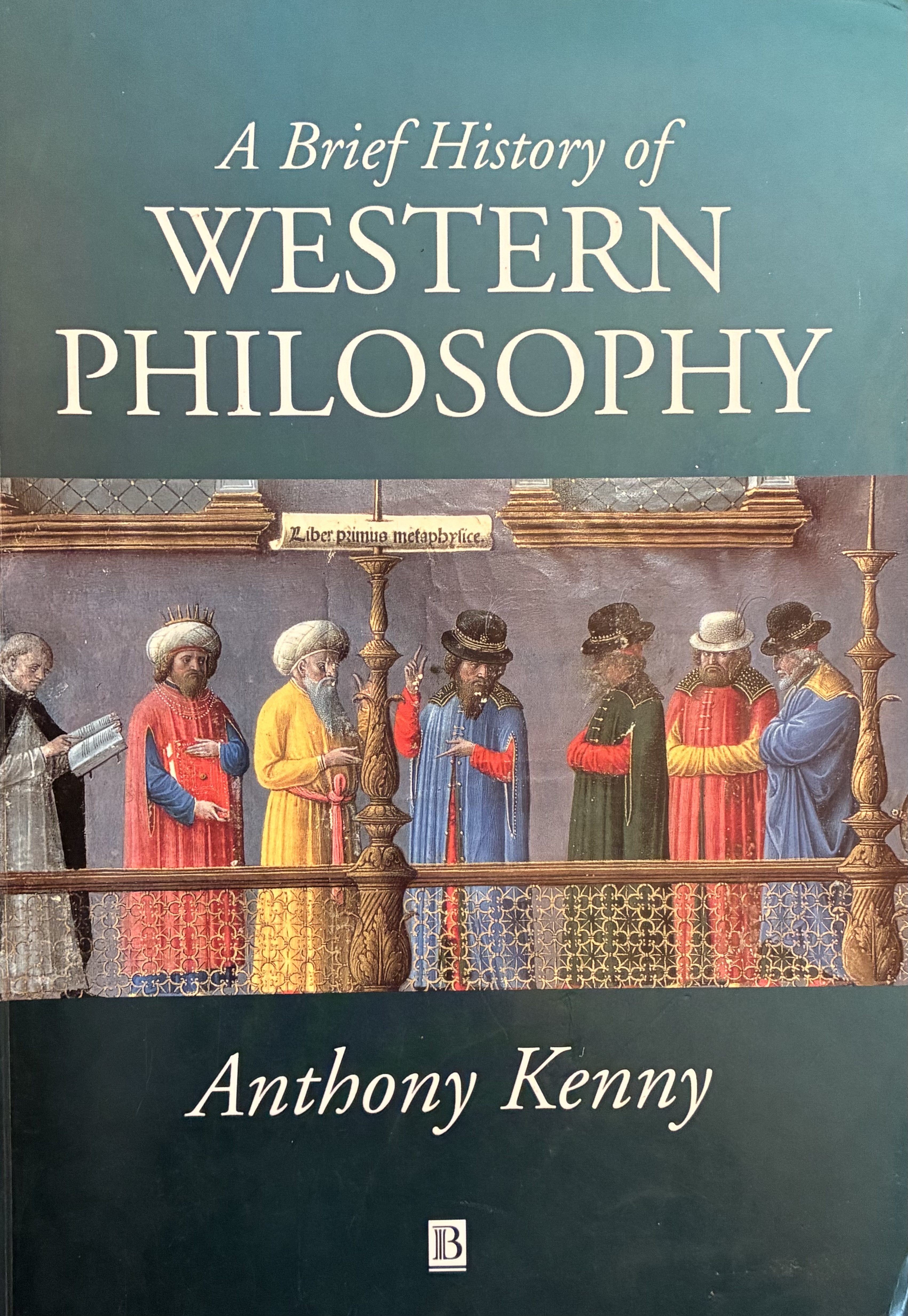
Excerpts from
A Brief History of Western Philosophy
Blackwell Publishers
Oxford, UK, 1998
John Cunyus
Searchlight Press