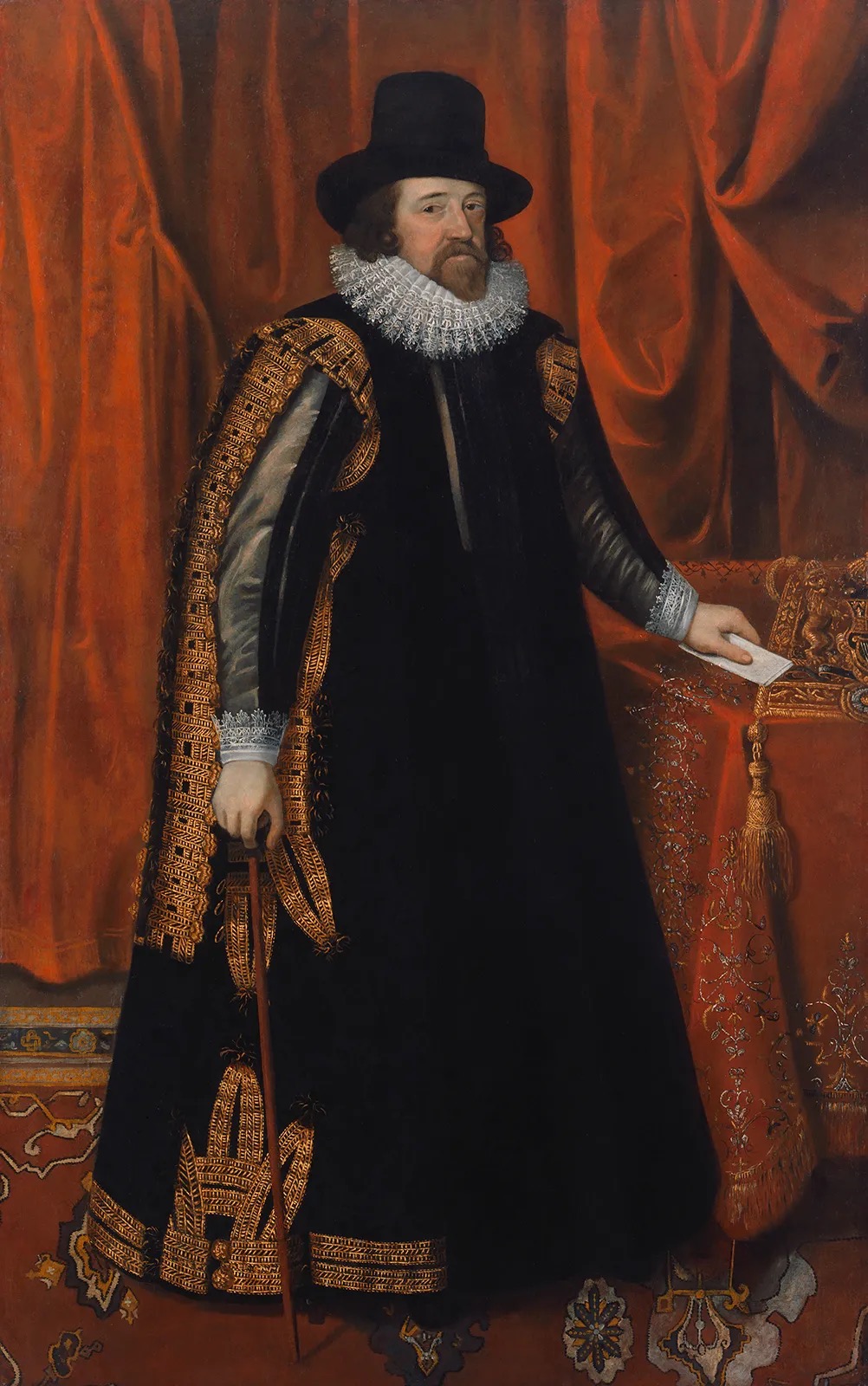
Francis Bacon, born in 1561 to aristocratic parents in England, rose to the office of Chancellor under James I. He fell from favor, though, accused of taking bribes, and died in 1625 without returning to political prominence.
His fame, however, grew from his philosophy, rather than his politics. Bacon was one of the first great philosophers of the scientific method. His pioneering insistence on experimental science, rather than philsophical abstraction, set the stage for illustrious British successors like Sir Isaac Newton, John Locke, and David Hume.
Essays, Civil and Moral was published in 1625, the year of his death, and his insights continue to shape the world's scientific, ethical, and political thought.
Quotes:
"Certainly, it is heaven upon earth, to have a man's mind move in charity, rest in providence, and turn upon the poles of truth."
"There is no vice, that doth so cover a man with shame, as to be found false and perfidious."
Pompa mortis magis terret, quam mors ipsa. “Death’s pomp will terrify more than death itself.”
Ut puto deus fio. “As I assume, I’m becoming a god!”
Vespasian.
"It is as natural to die, as to be born; and to a little infant, perhaps, the one is as painful, as the other."
"... all colors will agree in the dark:"
Tantum Religio potuit suadere malorum. “Only Religion could persuade of such evils.”
Lucretius, of Agamemnon.
"It was great blasphemy, when the devil said, I will ascend, and be like the highest; but it is greater blasphemy, to personate God, and bring him in saying, I will descend, and be like the prince of darkness; and what is it better, to make the cause of religion to descend, to the cruel and execrable actions of murthering princes, butchery of people, and subversion of states and governments?"
“You shall read (saith he) that we are commanded to forgive our enemies; but you never read, that we are commanded to forgive our friends.”
Cosmus, Duke of Florence.
"The virtue of prosperity, is temperance; the virtue of adversity, is fortitude; which in morals is the more heroical virtue."
Invidia festos dies non agit.
“Envy keeps no feast days.”
“Envy throws no parties.”
"Nuptial love maketh mankind; friendly love perfecteth it; but wanton love corrupteth, and embaseth it."
"It is a strange desire, to seek power and to lose liberty: or to seek power over others, and to lose power over a man's self."
Cum non sis qui fueris, non esse cur velis vivere. “When you cannot be what you were, there is no reason why you should want to live.”
"For they are the first, that find their own griefs, though they be the last, that find their own faults."
"For honor is, or should be, the place of virtue; and as in nature, things move violently to their place, and calmly in their place, so virtue in ambition is violent, in authority settled and calm."
"There is in human nature generally, more of the fool than of the wise; and therefore those faculties, by which the foolish part of men's minds is taken, are most potent."
"Certainly to men of great judgment, bold persons are a sport to behold; nay, and to the vulgar also, boldness has somewhat of the ridiculous."
"Goodness I call the habit, and goodness of nature, the inclination. This of all virtues, and dignities of the mind, is the greatest; being the character of the Deity: and without it, man is a busy, mischievous, wretched thing; no better than a kind of vermin."
"The desire of power in excess, caused the angels to fall; the desire of knowledge in excess, caused man to fall: but in charity there is no excess; neither can angel, nor man, come in danger by it."
Tanto buon che val niente:.
“...so good, that he is good for nothing.”
"Also, when discords, and quarrels, and factions are carried openly and audaciously, it is a sign the reverence of government is lost."
"So when any of the four pillars of government, are mainly shaken, or weakened (which are religion, justice, counsel, and treasure), men had need to pray for fair weather."
"And if this poverty and broken estate in the better sort, be joined with a want and necessity in the mean people, the danger is imminent and great. For the rebellions of the belly are the worst."
"The causes and motives of seditions are, innovation in religion; taxes; alteration of laws and customs; breaking of privileges; general oppression; advancement of unworthy persons; strangers; dearths; disbanded soldiers; factions grown desperate; and what soever, in offending people, joineth and knitteth them in a common cause."
"Above all things, good policy is to be used, that the treasure and moneys, in a state, be not gathered into few hands. For otherwise a state may have a great stock, and yet starve. And money is like muck, not good except it be spread."
"They that deny a God, destroy man's nobility; for certainly man is of kin to the beasts, by his body; and, if he be not of kin to God, by his spirit, he is a base and ignoble creature."
"IT WERE better to have no opinion of God at all, than such an opinion, as is unworthy of him."
Principis est virtus maxima nosse suos..
“The great strength of a Prince is to know his own.”
Mitte ambos nudos ad ignotos, et videbis.
“Send out both naked and unknown, and you will see.”
"And certainly it is the nature of extreme self-lovers, as they will set an house on fire, and it were but to roast their eggs; and yet these men many times hold credit with their masters, because their study is but to please them, and profit themselves; and for either respect, they will abandon the good of their affairs."
sui amantes, sine rivali.
“Lovers of self, without rival.”
(Quoted from Cicero)
"It is good also, not to try experiments in states, except the necessity be urgent, or the utility evident; and well to beware, that it be the reformation, that draweth on the change, and not the desire of change, that pretendeth the reformation."
Respondes, altero ad frontem sublato, altero ad mentum depresso supercilio, crudelitatem tibi non placere..
“You reply, with one eyebrow raised toward your forehead and the other lowered toward your chin, that cruelty does not please you.”
"But little do men perceive what solitude is, and how far it extendeth. For a crowd is not company; and faces are but a gallery of pictures; and talk but a tinkling cymbal, where there is no love."
Magna civitas, magna solitudo.
“Great city, great solitude.”
"A man cannot speak to his son but as a father; to his wife but as a husband; to his enemy but upon terms: whereas a friend may speak as the case requires, and not as it sorteth with the person."
"It never troubles a wolf, how many the sheep be."
Terra potens armis atque ubere glebae. .
“A land of mighty arms and of nourishing soil.”
"THERE is a wisdom in this; beyond the rules of physic: a man's own observation, what he finds good of, and what he finds hurt of, is the best physic to preserve health."
Parce, puer, stimulis, et fortius utere loris..
“Spare, boy, the whip, and better use the reins.”
"Certainly, he that hath a satirical vein, as he maketh others afraid of his wit, so he had need be afraid of others' memory."
"Seek not proud riches, but such as thou mayest get justly, use soberly, distribute cheerfully, and leave contentedly."
in sudore vultus alieni.
“In the sweat of a stranger’s face...”
"My judgment is, that they ought all to be despised; and ought to serve but for winter talk by the fireside."
"A man's nature, runs either to herbs or weeds; therefore let him seasonably water the one, and destroy the other."
Faber quisque fortunae suae.
“Each is maker of his own fortune.”
"There is no excellent beauty, that hath not some strangeness in the proportion."
"Beauty is as summer fruits, which are easy to corrupt, and cannot last; and for the most part it makes a dissolute youth, and an age a little out of countenance; but yet certainly again, if it light well, it maketh virtue shine, and vices blush."
"JUDGES ought to remember, that their office is jus dicere, and not jus dare; to interpret law, and not to make law, or give law."
Salus populi suprema lex.
“The people’s well-being is the supreme law.”
"The true religion is built upon the rock; the rest are tossed, upon the waves of time."
"Surely there is no better way, to stop the rising of new sects and schisms, than to reform abuses; to compound the smaller differences; to proceed mildly, and not with sanguinary persecutions; and rather to take off the principal authors by winning and advancing them, than to enrage them by violence and bitterness."